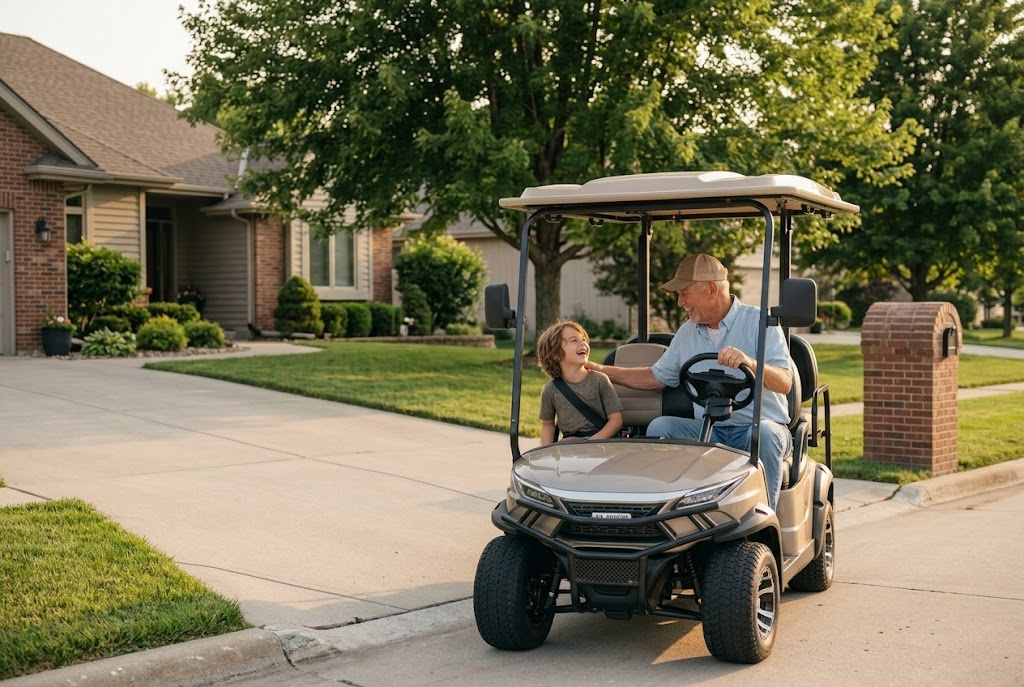
A cart that suits an active grandparent in Papillion, Gretna, or Elkhorn is not the fastest, loudest, or most accessorized one. It is the one that gets used most often — because climbing in is easy, the controls are obvious, the lights work, and the battery is ready whenever the next plan starts.
What “easy to live with” actually means
Most carts on a showroom floor look comparable. The differences that matter day-to-day are subtle, and they show up after a few weeks of ownership rather than during a test ride.
- Step-in height under roughly 14 inches — meaningful for stiff knees and hips.
- Seat height around 18–20 inches, with a flat cushion that is easy to slide across.
- Grab handles at the A-pillar and roof support, not just on the dashboard.
- Single-pedal drive (push to go, lift to slow) reduces foot work compared to separate accelerator and brake pedals.
- Push-button start or key fob is easier than a turn-key ignition for arthritic hands.
- A parking brake that engages with light pressure, not a stiff foot-set lever.
- Mirrors and a windshield as standard equipment, not as a $400 upgrade.
Seating that matches how a cart will actually be used
Two-seaters look efficient but rule out half the reason most grandparents want a cart in the first place. A four-seater with rear-facing back seats (a “2+2”) is the most flexible configuration for households where one or two grandkids visit regularly.
| Configuration | Best for | Trade-offs |
|---|---|---|
| 2-seater | Solo cruising, one passenger, short loops | No room for grandkids or a second couple |
| 4-seater (2+2 rear-facing) | One to two grandkids, easy parking, neighborhood use | Rear riders must be old enough to sit safely facing back |
| 4-seater (forward-facing) | Two adults and two kids in the same direction | Larger footprint; tighter in some garages |
| 6-seater limo | Group rides, large families, lake-community runs | Long; harder to maneuver and store |
Safety equipment worth paying for
Most of the safety features that matter are the same features that make a cart street-legal as a Low-Speed Vehicle. The LSV package is therefore usually the right choice, even for households that rarely intend to drive on public streets.
- Headlights, brake lights, and turn signals — visibility to drivers and to grandkids in driveways.
- Three-point seat belts on every seat, including rear-facing rows.
- Side mirrors and a center mirror, not just one or the other.
- A windshield with a wiper for spring rain and morning dew.
- A parking brake that holds reliably on the slight grades common in Papillion and Gretna subdivisions.
Battery choice for a low-maintenance year
For a cart that lives in an attached garage and gets used most weeks of the year, lithium is the simpler answer. There is no watering, no terminal cleaning, no winter sulfation risk if the cart sits a few weeks, and capacity loss in cold weather is moderate rather than steep.
A lead-acid pack can still make sense for a cart that is fully winterized from November through March and used lightly the rest of the year. Most active grandparents are not that household — short Saturday loops in 40-degree weather are exactly the kind of use lithium handles better.
Where it can legally be driven
A non-LSV golf cart is restricted to private property and to streets where a local ordinance specifically allows it. An LSV titled and registered in Sarpy or Douglas County may operate on roads with posted speed limits of 35 mph or less, subject to local rules. Most Papillion, Gretna, and Elkhorn residential streets qualify; arterial roads do not.
A reasonable budget
For a new four-seater LSV with lithium batteries and a street-legal package, Omaha-area pricing typically runs $16,000–$22,000. Certified pre-owned drops that meaningfully, and private-party lithium carts in good condition occasionally come up under $13,000. Lead-acid private-party carts are cheaper but carry battery-replacement risk.
Frequently asked
Is a special license required to drive a golf cart in Papillion?
A standard Class O Nebraska driver’s license covers operation of an LSV on public streets. A non-LSV golf cart on private property or where a local ordinance specifically allows it generally follows the rules in that ordinance.
Are grandkids allowed to ride in the front seat?
Nebraska does not impose a separate front-seat age rule for LSVs beyond standard child-restraint laws. The practical answer is that any rider should be tall enough that the seat belt sits across the shoulder, not the neck.
How far can a typical lithium cart go on a charge?
A modern lithium pack on a four-seater commonly delivers 40–60 miles of range in mild weather — far more than a typical day of neighborhood use. Cold weather and hills lower that, but rarely below 25 miles.
Is a cart loud enough that neighbors will notice?
No. Electric carts are quieter than a passing bicycle. The only audible sound at low speed is tire noise.