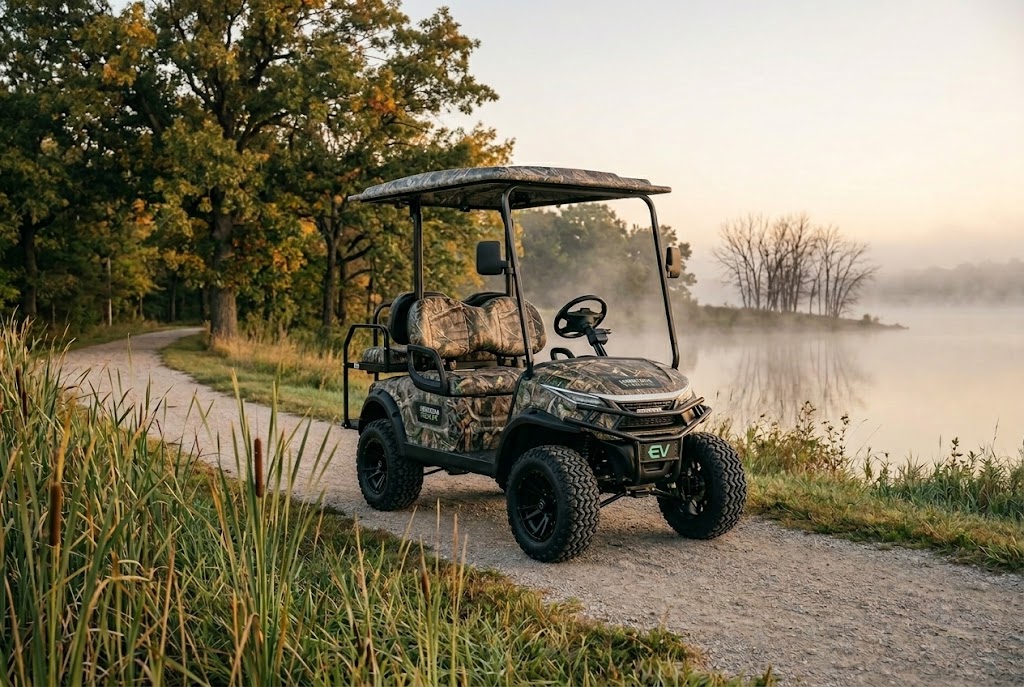
Lake-adjacent neighborhoods in the Omaha metro use a cart differently than a typical suburban household. Trips are shorter on average, the route mixes asphalt with the occasional crushed-limestone trail, and the cart spends meaningful time outdoors near humidity and pollen. A cart chosen for that pattern lasts longer and stays cheaper to keep.
The Omaha-area lakes that anchor demand
- Walnut Creek Lake Recreation Area (Papillion) — Sarpy County’s largest recreation lake; paved loop around the water; nearby subdivisions are the strongest local cart market.
- Lake Zorinsky (west Omaha) — long paved trail, popular for fishing and morning loops; neighborhood access from multiple sides.
- Lake Cunningham (north Omaha) — open paved areas and a boating community; popular for short evening cruises.
- Prairie Queen Lake (Papillion) — newer recreation area with paved trails and growing nearby development.
- Chalco Hills Recreation Area (La Vista) — mixed paved and crushed-rock trails; popular among the lake-loop crowd even without lakeside homes.
What matters more for lake-adjacent use
A cart for a lake community does not need to be faster than one for a typical subdivision. It does need to do a few specific things well.
| Factor | Why it matters at the lake |
|---|---|
| Real-world range | Loops around larger lakes are longer than they look; range pressure compounds over a full day. |
| Quiet operation | Wildlife, neighbors, and early-morning fishing all reward an electric drivetrain. |
| Weather sealing | Lake humidity, pollen, and surprise spring storms test gaskets and seat materials. |
| Tire choice | Stock turf tires struggle on crushed limestone; all-terrain tires hold up better. |
| Storage footprint | Lake-community garages are often shorter than standard subdivision builds. |
Range and the loop math
The full paved loop at Walnut Creek Lake is roughly 3.5 miles. Zorinsky’s perimeter trail is closer to 5.5 miles. A neighborhood cart that does the loop, returns home, and still runs errands the same afternoon needs comfortable range of 25 miles or more after accounting for cold-weather loss. Most modern lithium four-seaters clear that easily; lead-acid carts older than three years often do not.
Trail and park rules
Each lake is managed by a different agency, and rules vary. Most paved trails around Omaha-area lakes are designated for pedestrians and bicycles. Golf carts and LSVs are generally not permitted on those trails themselves, even when neighborhoods nearby allow street operation.
Lift kits and tire upgrades
A modest 3–4 inch lift with all-terrain tires is a popular upgrade in lake communities — and the one accessory that tends to return its cost at resale. It clears curbs and crushed-limestone shoulders without changing the cart’s handling enough to feel unstable. Larger lifts look striking but raise the center of gravity and reduce stability on side-slopes near the water.
Off-season storage near the water
Lake-community garages run a bit damper than typical suburban garages, especially in early spring. A few practical steps protect the cart through Nebraska’s off-season.
- Charge the pack to its recommended storage level — usually 50–60% for lithium, full charge on a maintainer for lead-acid.
- Disconnect the battery main if the cart will sit more than 30 days.
- Cover the cart with a breathable cover; sealed plastic traps humidity.
- Treat vinyl seats with a UV-stable conditioner before storage, not after.
- Inflate tires to the upper end of the rated range to avoid flat spots.
Frequently asked
Can a golf cart be driven on the paved trail around Walnut Creek Lake?
The Walnut Creek Lake paved loop is managed as a pedestrian and bicycle trail. Motorized vehicles, including golf carts and LSVs, are generally not permitted on the loop itself. Adjacent neighborhood streets may allow LSV operation under Papillion’s ordinance.
Are LSVs allowed on the streets inside lake-area subdivisions?
In Papillion, an LSV titled, registered, and insured under Nebraska law may operate on streets with posted speed limits of 25 mph or less, subject to the city’s current ordinance. Most subdivision streets near Walnut Creek and Prairie Queen qualify.
Is a six-seater overkill for lake-community use?
Sometimes. Six-seaters earn their length on group rides and lakeside socializing but are noticeably harder to park in older lake-community garages. A four-seater 2+2 fits most households without the trade-offs.