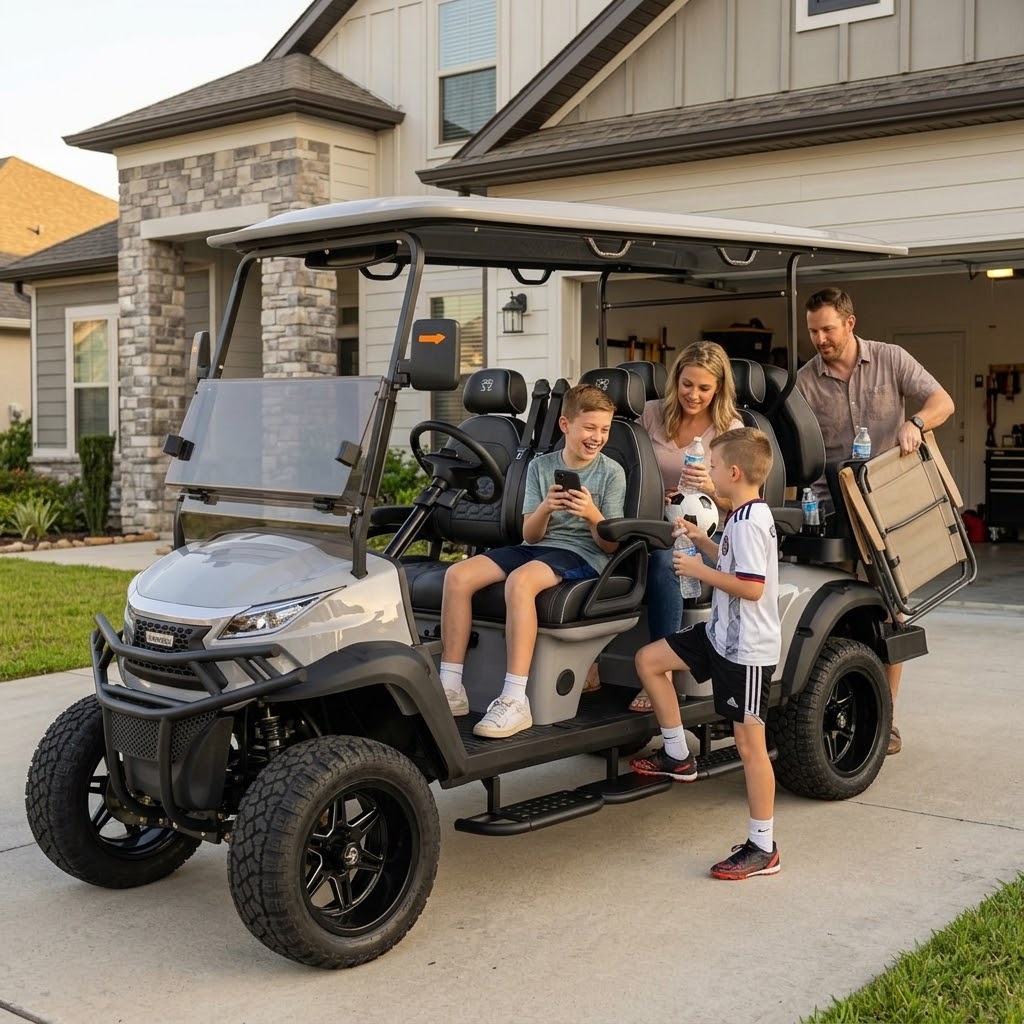
Family use is the broadest category in the Omaha-area golf cart market. The trips a family cart actually does — practice drop-offs, the run to the park, hauling yard tools to the back property line, the after-dinner loop — define the right configuration far more than seat count alone.
How families actually use a cart in Omaha-area subdivisions
- Driveway-to-practice runs in Papillion-La Vista, Gretna, or Elkhorn neighborhoods.
- Sports equipment hauling — golf bags, soccer gear, a kid’s bike that needs to come home.
- Yard work and property maintenance on larger Gretna or rural-edge lots.
- Evening loops with kids and a neighbor or two riding along.
- Trips to the community pool, neighborhood park, or HOA mailbox cluster.
Seating layouts and how they fit family life
| Configuration | Real-world capacity | Best fit |
|---|---|---|
| 4-seater, forward-facing | Two adults, two kids in a second forward row | Households with younger kids who prefer to face forward |
| 4-seater, 2+2 rear-facing | Two adults, two kids in a rear-facing back bench | Most flexible — kids enjoy the rear seat; converts to a cargo deck |
| 6-seater limo | Two adults, four kids comfortably | Larger families, carpooling neighbors, lake-community use |
| Utility-style with cargo bed | Two adults plus tools or gear | Larger lots or properties that need a real cargo bed |
Safety when kids ride along
A cart that carries children should be specified to the same standard as a household second vehicle, even if it never leaves the neighborhood.
- Three-point seat belts on every seat, not lap belts only.
- Side rails or hip restraints on rear-facing seats.
- Headlights, brake lights, and turn signals — visibility for kids on bikes and neighbors backing out of driveways.
- A wide mirror set: both side mirrors and a center mirror.
- A slow-start or governor mode that limits acceleration when a younger driver-in-training is at the wheel.
Built for outdoor life
A family cart spends meaningfully more time outside than a grandparent cart, and the durability gap shows up after three or four seasons.
- A powder-coated frame holds up to Nebraska winters better than painted steel.
- Aluminum body panels do not rust where stone chips and salt residue collect.
- Sealed bearings in the wheel hubs survive lake-community pollen and driveway sand.
- A roof rated for sun and hail, not just rain — important on west-facing Gretna and Elkhorn driveways.
Customization that pays back vs. customization that does not
Family carts attract more accessory spending than any other category. Some upgrades return their cost at resale; many do not.
| Upgrade | Holds value at resale? |
|---|---|
| Modest lift kit and all-terrain tires | Usually yes — broadens the buyer pool |
| Hard-top enclosure with doors | Usually yes — extends usable season |
| Upgraded lithium battery pack (factory) | Yes — the largest single value driver |
| Custom paint and graphics | Rarely — taste is personal |
| Premium sound system | No — almost never returns full cost |
| Lighting accent kits | No — easily replicated by the next owner |
Cost over the life of the cart
A well-specified family LSV in the Omaha metro typically costs $17,000–$24,000 new with lithium batteries. Over an 8–10 year ownership horizon, the dominant cost is not purchase price — it is battery replacement on a lead-acid cart, which can run $1,500–$2,500 every 4–6 years. A lithium pack usually outlasts the original ownership period.
Frequently asked
What age can a child ride safely in a family cart?
Standard Nebraska child-restraint laws apply to any vehicle operated on public roads, including LSVs. As a practical matter, a child should be tall enough for the lap and shoulder belt to fit properly across the chest and hips.
Is a 6-seater hard to park in a normal subdivision garage?
Often, yes. Six-seater LSVs commonly run 12–13 feet long. A standard three-car garage stall in newer Gretna and Papillion construction handles them; a 1980s-era two-car garage often does not.
Can a teenager drive an LSV on neighborhood streets?
On public roads, an LSV is a titled motor vehicle and requires a valid Class O Nebraska operator’s license. A learner’s permit holder follows the same rules as in any other vehicle.
Does a family cart need its own insurance policy?
An LSV operated on public roads requires liability insurance under Nebraska law. Many household auto policies add an LSV as a low-cost endorsement rather than requiring a standalone policy. Confirm coverage with the carrier before relying on it.